In our recent LettsNews blogs, we’ve focused heavily on how to create a story, and how to use NewsAgent. This week we are changing our focus because none of that matters without one thing, trust.
And trust begins with fact-checking.

We are operating in a period where trust in mainstream media is under significant scrutiny. Factors including political agendas, algorithm-driven outrage, misinformation networks, and the rapid pace of social publishing have all contributed to a fragile information ecosystem.
The rise of AI has only intensified this debate.
Generative systems can produce convincing narratives in seconds, but speed without verification can lead to misinformation. Audiences are increasingly sceptical; they question sources and scrutinise claims. Research shows that once trust is lost, it is exceptionally difficult to rebuild.
As Peter Prince , our CMO, wrote in a recent LinkedIn article “Reclaiming Trust in the Age of AI” , journalism must not retreat from technology; it must harness it responsibly. AI should not replace editorial judgement but rather strengthen it.
Fact-checking is where that responsibility becomes real.
Fact-checking is not simply about correcting mistakes. It serves four essential purposes:
A single unchecked statistic can undermine an entire publication's credibility.
In politically polarised environments, selective data and misleading framing are common tactics. Rigorous verification protects against becoming an unwilling amplifier of misinformation.
Content that is inaccurate becomes disposable, while verified content can serve as valuable reference material.
When journalists know their work has been systematically checked, they publish with greater authority and confidence.
In short, fact-checking is not a delay in the process, it is the foundation of sustainable journalism and credible content.
AI presents a paradox:
However, AI systems can also:
That is why the question is no longer, "Should we use AI?" but rather, "How do we build verification directly into the workflow?"
That is precisely what we have done with LettsNews.
LettsNews integrates fact-checking into the story creation flow, rather than treating it as an afterthought.
Whether you begin with NewsAgent or draft manually, LettsNews structures your content clearly. This structure makes claims visible and reviewable, which is a critical first step in verification.
Once a draft is complete, the fact-checking tool scans and flags statements that require verification. This does not override the journalist; it surfaces areas for review, keeping editorial control firmly in human hands.
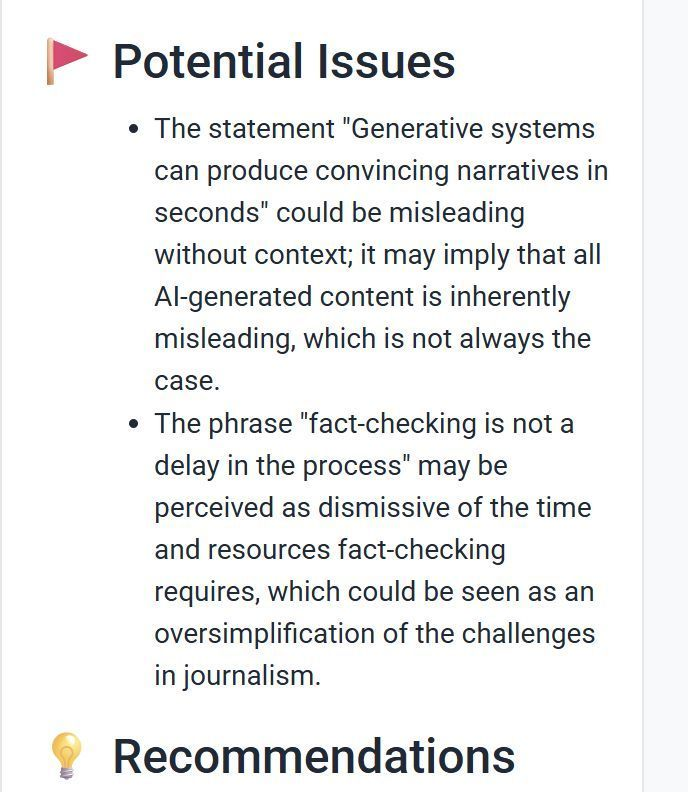
From there, you can:
This stage transforms AI-assisted drafting into accountable journalism.
The result is a story that moves quickly from idea to draft, includes a review layer that strengthens credibility, and produces a final piece that is defensible.
Fact-checking becomes part of the creative rhythm, not an obstacle to it.
Large media organisations traditionally had layers of editors and fact-checkers that independent journalists and creators often do not. LettsNews is designed to level that playing field. By embedding structured drafting, AI assistance, and built-in review mechanisms, the platform supports faster turnaround, reduced risk of error, and stronger audience trust, thereby building long-term credibility. Trust is not merely assumed in the current climate; it is earned, line by line.
The future of journalism will not be defined by rejecting AI.
It will be defined by those who use it responsibly, and in that context, fact-checking is not just a technical feature but a clear editorial principle.
At LettsNews, we believe technology should protect the integrity of storytelling, and that in a world where misinformation travels faster than ever, responsible verification is essential.
If you would like to experience how fact-checking works inside LettsNews, you can sign up for FREE today and explore the full story workflow from idea generation to verified publication.
Because great journalism is not just about telling stories; it’s about telling stories that stand up to scrutiny.